Dreaming about a home with room to spread out around Topeka? A little extra land can open up a lot of possibilities, but it also adds layers that many buyers do not face on a standard in-town purchase. If you want acreage for privacy, hobbies, animals, or outbuildings, it helps to know what to check before you fall in love with the property. Let’s walk through the biggest things to understand when buying a home with land around Topeka.
Why acreage buying is different
When you buy a home with land, you are not just buying a house. You are also buying access, utilities, drainage, land use limits, and long-term maintenance responsibilities.
Around Topeka, that often starts with one basic question: who has jurisdiction over the property? Inside Topeka city limits, planning, zoning, permits, and inspections are handled by the City of Topeka. In unincorporated Shawnee County, those functions are handled by Shawnee County Land Use & Development.
That difference matters because a property can feel rural but still be subject to city rules, county rules, or both. If a parcel sits inside the city’s three-mile jurisdiction, land division must be approved by City Planning before a county building permit can be issued.
If you are looking at a home with pasture, a shop, fencing, or room to build later, this is one of the first things to confirm. It helps you understand what you can do with the property now and what approvals you may need later.
Start with the land itself
With acreage, the land deserves as much attention as the house. Before you move forward, it helps to think about how the site actually functions.
K-State recommends identifying the likely locations for the home, well, and wastewater system before finalizing a purchase. It also advises buyers to check soil suitability for foundations, septic systems, roads, and driveways.
This becomes even more important if the property has steep slopes, rock, clay soils, water features, floodplain areas, or marshy ground. A beautiful view or open field does not always mean the site is simple to use or improve.
A smart next step is making sure your purchase plans match the land’s physical limits. If you hope to add a building, expand a driveway, or use part of the property differently in the future, those details should be reviewed early.
Check water and wastewater carefully
On rural and edge-of-town properties, private wells and septic systems often replace full municipal service. That changes your due diligence in a big way.
Private well basics
If the home has a private well, you should treat water quality as your responsibility to verify. The Kansas Department of Health and Environment says private well owners are responsible for water quality and recommends annual testing for coliform bacteria and nitrates.
KDHE also notes that the well’s location and construction should be assessed before testing. If a well is shallow, hand-dug, open to runoff, or close to a pollution source such as pasture, feedlots, septic systems, or fertilizer storage, extra attention is important.
K-State also recommends annual checks of the casing, cap, pitless adapter, grading around the well, and testing for coliform bacteria, nitrate, pH, and total dissolved solids. For buyers, the key takeaway is simple: test the well before closing and understand what you are inheriting.
Septic system basics
Septic systems need more than a quick glance. Shawnee County explains that a septic system includes a tank and disposal field, and the system size is based on a percolation test and bedroom count.
In unincorporated Shawnee County, permits are required for new septic installations and repairs. K-State recommends getting complete information about the existing water supply and wastewater system, locating the property boundaries, well, and wastewater system, confirming setback distances, and having the septic system inspected by a trained person.
This is one area where a general home inspection may not be enough on its own. A trained septic professional can help you understand condition, maintenance needs, and whether the system appears to match the property and local requirements.
Do not overlook access and driveways
Access can be easy to miss when you are focused on the home itself. On acreage properties, it deserves its own review.
In Shawnee County, new driveway entrances, culverts, and modifications must be approved and permitted by Public Works. The county also directs buyers to confirm road maintenance responsibility.
That means you should ask questions like:
- Who maintains the road?
- Is the current entrance permitted?
- Will changes to the driveway or culvert require approval?
- Are there seasonal access issues after heavy rain or snow?
These details can affect convenience, future costs, and even whether planned improvements are practical.
Review floodplain risk early
Flood risk is another issue that can matter more on larger or more rural parcels. Low areas, creek bottoms, and drainage corridors deserve a closer look, even if the main house seems well placed.
Shawnee County says floodplain regulations apply in unincorporated areas mapped as special flood hazard areas, and development in those areas requires a floodplain development permit. The county also notes that properties in a special flood hazard area have a 26 percent chance of flooding over the life of a 30-year mortgage.
This is why checking maps early matters. A lot that looks usable at first glance may have limits on future building, grading, or expansion.
Verify outbuildings and improvements
One of the biggest draws of acreage is often the extra improvements. Shops, barns, sheds, fencing, and long driveways can add real function to a property.
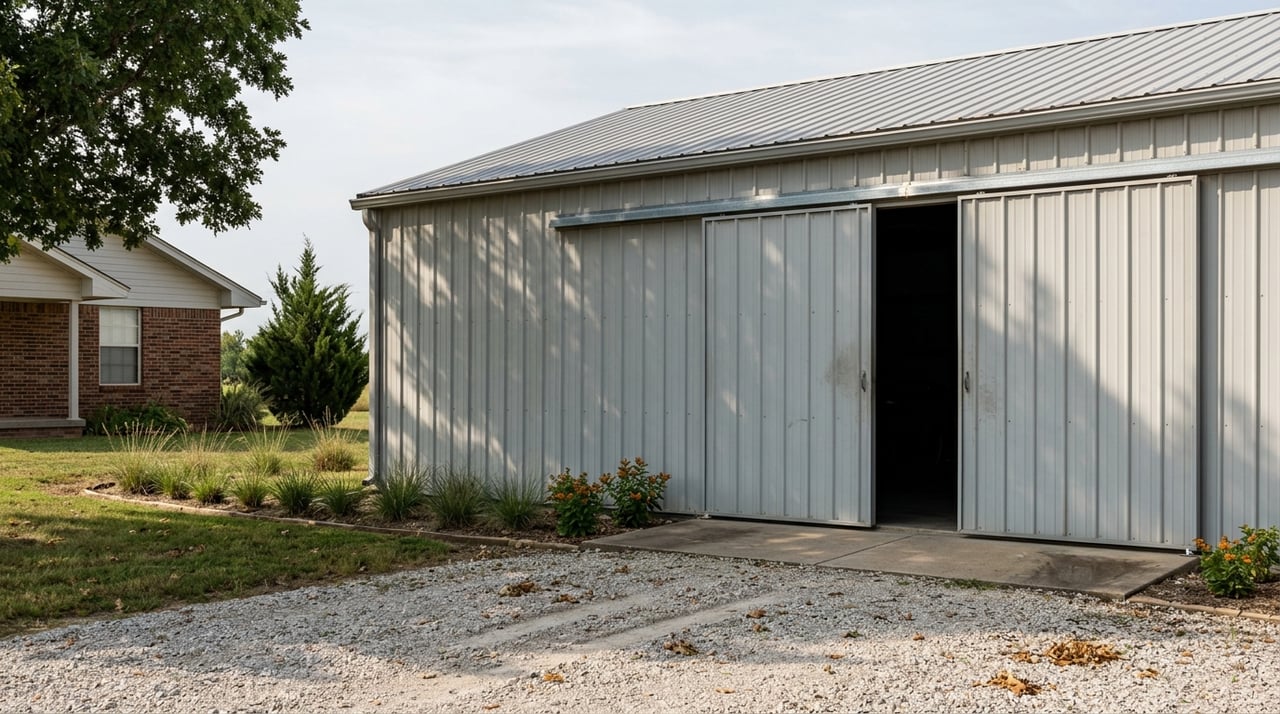
They can also raise questions if they were built without the right permits. Shawnee County requires permits for accessory structures, and the county states that work on a structure subject to a county permit cannot begin before the permit is issued. In Topeka, the city issues permits for fences, driveways, and residential construction.
So if a property already has a large shop, detached building, fence, or driveway upgrade, do not assume it is automatically approved just because it exists. It is worth checking permit history and current compliance before you close.
Understand taxes and carrying costs
Acreage can change your monthly and yearly costs in ways that are not obvious at first. That is why it helps to look beyond the list price.
Agricultural classification
Some buyers assume land automatically gets agricultural tax treatment. In Kansas, that is not how it works.
The Kansas Department of Revenue says agricultural land is valued on productive potential rather than fair market value, and classification depends on actual use, not size alone. The county appraiser records the property’s current usage and acreage.
If part of a property is used for farming or grazing, ask how it is currently classified. It is better to verify than to make assumptions about future tax bills.
Special assessments and fees
Kansas law requires sellers to disclose if a property is subject to a special assessment or fee or is located in an improvement district. On larger parcels, this can matter because roads, drainage, and utilities may affect the true cost of ownership.
That is why I always encourage buyers to look closely at the full carrying cost, not just the payment estimate. A property with more land can bring more freedom, but it can also bring more line items.
Utility responsibility
On edge-of-town properties, utility responsibility can shift depending on location. In Topeka, the city says water lines from the meter to the structure, along with lines on private property, are the owner’s responsibility.
The city’s stormwater utility is also based on impervious area. That means larger driveways, parking areas, or shop roofs may affect costs more on city-limits parcels than on a typical in-town lot.
Plan for more hands-on ownership
Many buyers love acreage because it offers privacy, flexibility, and room to build a lifestyle. That can absolutely be worth it, but it helps to go in with clear expectations.
Private wells need regular testing and basic wellhead protection. Septic systems need monitoring and periodic pumping so solids do not damage the absorption field.
In other words, a home with land often means you will personally manage more systems than you would with a home connected to full municipal service. If you know that up front, you can budget better and avoid surprises.
A practical buying checklist
If you are shopping for land around Topeka, here are some of the most important items to review before closing:
- Confirm whether the property falls under Topeka, Shawnee County, or both
- Review zoning and land use rules for the parcel
- Check likely locations and suitability for well and wastewater systems
- Test private well water and review well condition
- Have the septic system evaluated by a trained professional
- Confirm road maintenance and driveway or entrance permit requirements
- Review floodplain maps and permit needs
- Verify permit history for barns, shops, sheds, fences, and driveways
- Ask about special assessments, fees, or improvement district status
- Verify current property use and tax classification
When you take these steps early, you can make a more confident decision and avoid buying a property that fits your dream on paper but becomes a challenge after closing.
If you are considering a home with land around Topeka, having a local guide who understands both the market and the practical side of property condition can make the process feel much less overwhelming. If you want a steady, no-pressure conversation about what to look for, reach out to Wendie Edwards to schedule a consultation.
FAQs
What should you check first when buying a home with land around Topeka?
- Start by confirming whether the property is inside Topeka city limits, in unincorporated Shawnee County, or within the city’s three-mile jurisdiction, because that affects zoning, permits, and future improvements.
Should you test a private well before closing on a Shawnee County acreage property?
- Yes. KDHE recommends private well testing, and K-State advises making the purchase contingent on a sufficient source of safe drinking water.
Does a septic system on rural property near Topeka need a specialized inspection?
- Yes. K-State recommends inspection by a trained person who can review the wastewater system, setbacks, and local requirements.
Do you need to verify permits for barns, shops, sheds, or fences on Topeka-area acreage?
- Yes. Existing structures and improvements should not be assumed compliant just because they are already on the property.
Does larger land around Topeka automatically qualify for agricultural tax treatment?
- No. In Kansas, agricultural classification depends on actual use, not acreage size alone.